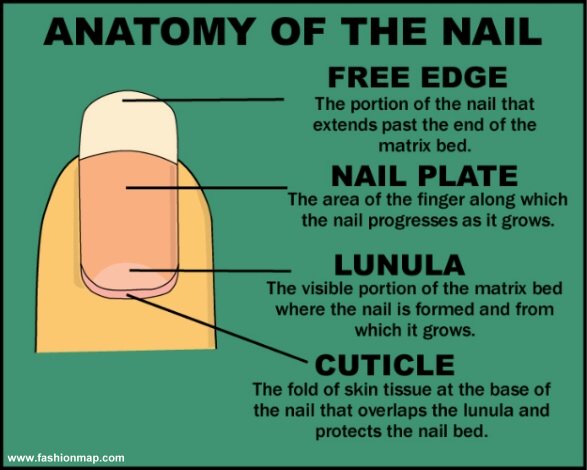
Do you have short nail beds? Long nail beds? Wide nail beds? Do you even know the difference? It's difficult to tell sometimes since there is no defined length or width for nails. The reason for this is that everyone's fingers are a different length and width. The size and shape of the nail should be in proportion to the size and shape of the nail bed and the fingers. When your nails are within proportion, they are at their strongest and most appealing. So how do you know what length and shape to make them? Well that's where it gets a little tricky...let's take a look at a few nails shall we?

I bet it didn't take you very long to figure out what the issue here is. The nails are too long. Some of you might be intrigued by this but I'd bet less than 10% of you looked at this picture with any kind of envy or adoration. These nails are way out of proportion. Now let's look at another picture:

Again I'm sure it doesn't take very long to figure out the problem here. The nails are way too short. Not just SHORT but these nails are actually some that have been bitten and you can see where the nail bed is becoming injured and growing a new "skin" which will keep these nails stunted for life. It's easy to spot the problems when they're super obvious but how can you tell when nails are just slightly dis-proportioned? My intention here is not to make fun of anyone or look down on anyone so I didn't want to pull any pictures from the web for this lest anyone should come across them and feel badly about themselves. So let's look at my nails for a minute:

I'm lucky because I have naturally long nail beds which means that unless I grow my nails to ridiculous lengths, they are always in proportion. Here's how you can tell if you do too:

I've labeled the width and length of my nail bed here. I want you to notice that I did not include my free edge when I did the length. I'm showing you my nail BED not my nail PLATE. It's important to see the difference. The nail plate you can control. The nail bed you cannot. You can see that the length of my nail bed not only exceeds the width but is more than double the length as the width. This is a proportioned nail. Why?
Aesthetically speaking the preferred width to length ratio is 50%. In plain English that means that the width of your nail should be no more than half the length of the bed. If the width is more than half the amount of your bed length then your nails are wide. If the length is less than twice the length of the width, your beds are short. If the length exceeds the width by 50% your nails are perfectly proportioned and if it exceeds it by more than 50% (as mine do) your beds are long. Now that you know what makes a short nail bed, the next question will be how to fix it.
You have no control over the width of your nails. So the variable here will be the length. The easy thing to do is to grow nails to the length that will be twice (or close to) the length of the width of your nail bed. The perfect length for everyone will vary BUT there are a few things to keep in mind when growing your nails out. One thing is that there is a perfect length for your nail type, structure and usage level. You probably already know what this is because your nails will begin to break after that point. You can increase it by changing your habits, diet, or adding strengtheners to your routine. Another thing to remember is that your nails have a delicate structure and you don't want to unbalance them. Nails should never exceed in length the total length of the nail bed. You can see the line I showed you on my nails to display the length of my nail bed. If I were to measure that line and reposition it to start at my free edge (the area where it first begins to look white) you would be able to see the maximum length my nail bed will support. Growing your nails past that point not only looks unbalanced but also weakens your nail. Try this trick at home to see what I'm talking about:
Place a pencil or pen on a table. Now move it towards the edge slowly, so that the end of it begins to hang over the edge of the table. Inch it forward slowly and wait for the point where it falls off. It should be at just over half the length of the pencil. Every millimeter your nail grows slightly weakens it's structure, just like with the pencil and at some point, it will become too much. Keep those tips in mind and you'll be on the way to beautiful proportioned nails in no time!!
Please note: These opinions are that of trained professionals and facts from many years of research. No two people have the same nails and you are the only one who can say if you like them or not. This is to be used as a guide for those who want to achieve healthy, structurally proportioned nails and is not to be looked at as an assault on anyone's individual opinions or choices.
- 7:40 PM
- 18 Comments